

Club & Membership Software Development
Spent $50k on membership software and still drowning in spreadsheets? Members lapsing because manual renewal reminders never sent? We've built custom membership management systems for 35+ clubs and communities. Our platforms eliminate administrative chaos, automate renewals, and prepare your organization for real growth. Most clients see 50-70% efficiency gains within 8-12 weeks. Production-ready in 10-14 weeks.
Common Industry Challenges
Organizations face unique challenges that impact operations, compliance, and efficiency.
Drowning in Spreadsheet Hell
Description
Managing members across multiple Excel sheets with different departments keeping their own versions. Staff spending 20+ hours weekly on manual data entry, duplicate records appearing everywhere, and renewal reminders sent inconsistently or not at all. When someone asks for a member report, it takes 3 days to compile accurate data. If it's even possible. 94% of organizations perform repetitive, time-consuming manual tasks that membership software should automate.
Impact
Our Software Solutions
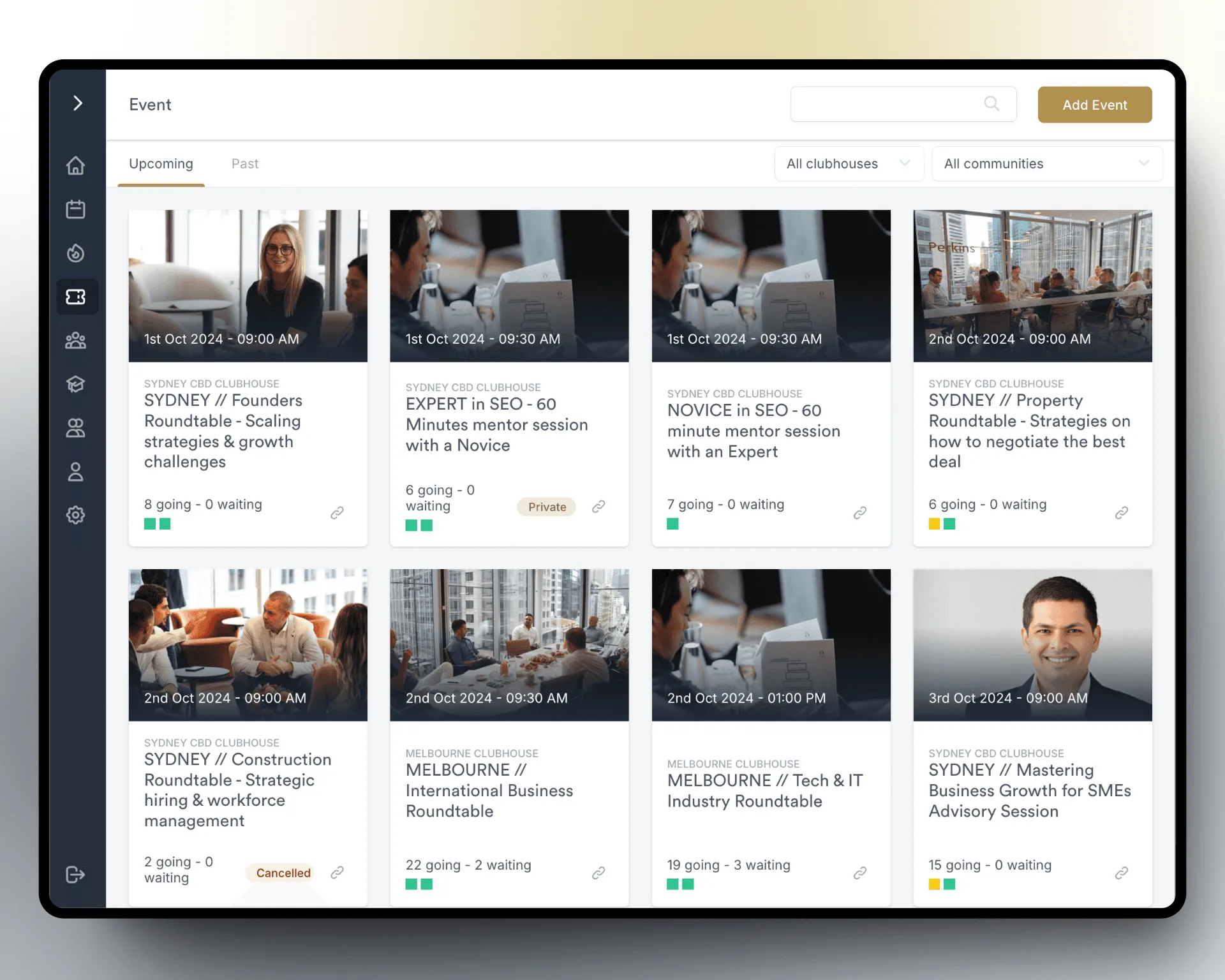
Centralized Membership Database

Automated Renewal Management

Member Engagement Platform

Integrated Payment Processing

Member Self-Service Portal
Types of Software We Develop
We specialize in complex, data-heavy industrial applications where off-the-shelf software falls short.

Membership Management Systems (MMS)
Description
Core membership management systems handle the fundamental operations of member-based organizations. Member records, renewals, communications, and basic reporting. These systems serve as the central hub for member data, tracking membership status, contact information, payment history, and basic engagement metrics. MMS platforms typically include member databases, automated renewal reminders, payment collection, and email communications. They're designed for organizations where membership management is the primary operational focus, such as professional associations, alumni groups, or hobbyist clubs. While MMS platforms handle core membership functions well, they often lack deep functionality for complex needs like event management, learning programs, or advanced analytics. Requiring integration with specialized systems or upgrades to full Association Management Software. Most suitable for organizations with 100-1,000 members and straightforward membership models. We build custom MMS when your membership structure doesn't fit off-the-shelf templates or you need specific workflows, integrations, or reporting that standard platforms don't support.
Key Modules & Features

Real World Use Cases
How we apply our engineering standards to solve complex problems.
Technologies & Integrations
| System Type | Common Tools | Our Capabilities |
|---|---|---|
| Payment Processing Systems | Stripe, PayPal, Authorize.net, Square, Braintree, Worldpay, Adyen, Bank merchant accounts | Recurring billing, subscription management, failed payment retry, payment method tokenization, PCI compliance, fraud detection, refund processing, multi-currency support, payment plans, invoice generation |
| Email Marketing & Communication Platforms | Mailchimp, Constant Contact, SendGrid, Postmark, Amazon SES, Campaign Monitor, HubSpot Email, ActiveCampaign | Bulk email campaigns, transactional emails, email templates, segmentation, A/B testing, automated workflows, deliverability management, bounce handling, unsubscribe management, campaign analytics |
| Accounting & Financial Systems | QuickBooks Online, Xero, NetSuite, Sage Intacct, MYOB (Australia), FreshBooks, Wave, Zoho Books | Invoice sync, payment reconciliation, GL coding, accounts receivable, revenue recognition, expense tracking, financial reporting, audit trails, tax compliance, multi-entity accounting |
| CRM & Sales Platforms | Salesforce, HubSpot CRM, Microsoft Dynamics 365, Zoho CRM, Pipedrive, Nimble, Copper CRM | Contact sync, lead management, opportunity tracking, pipeline visibility, activity logging, email integration, task management, reporting and dashboards, custom fields, workflow automation |
| Event & Webinar Platforms | Zoom, Microsoft Teams, Eventbrite, Hopin, vFairs, Cvent, GoToWebinar, Webex, ON24 | Virtual event hosting, registration integration, attendee management, session scheduling, recording access, attendance tracking, breakout rooms, networking features, poll and Q&A integration |
Custom vs. Off-the-Shelf Software
Understanding the differences helps you make the right choice for your organization.
Details:
4-6 months initial build with phased rollout, but designed exactly for your workflows from day one. No compromisesDetails:
Quick initial setup (2-4 weeks), but 6-12 months customizing to match workflows, with many compromises acceptedDetails:
$50k-$250k depending on complexity, but no recurring license fees. Only hosting ($200-$500/month) and optional supportDetails:
$5k-$25k setup + $200-$2,000/month subscription ($24k-$240k over 3 years for larger orgs)Details:
$75k-$300k (build + hosting + maintenance). Typically 20-40% less for complex organizations over 3 yearsDetails:
$100k-$350k (setup + subscriptions + customization + per-user fees + integration costs)Details:
Built around exactly how your organization operates. 100% workflow match with no compromises or workaroundsDetails:
Forces your organization to adapt to vendor's predetermined workflows. 80% spend customizing but still compromising on 30% of needsDetails:
Supports any membership structure. Complex hierarchies, multiple contact types, custom billing logic, unlimited flexibilityDetails:
Handles standard individual/organizational tiers, struggles with complex hierarchies, family plans, or multi-entity structuresDetails:
Integrates with any system via API. Legacy databases, specialized industry tools, proprietary systems. No limitationsDetails:
Pre-built integrations with popular tools (Mailchimp, Stripe, QuickBooks), custom integrations require expensive add-ons or impossibleWhy Clubs & Associations Trust StepInsight
Certifications & Expertise
- SOC 2 Type II compliant infrastructure
- PCI DSS Level 1 payment processing
- Google Cloud platform expertise
- Privacy Act 1988 (Australia) compliant
Industries Served
- Professional Associations
- Trade Associations
- Social & Community Organizations
- Member-based Businesses
- Alumni Associations
- Sports & Recreation Clubs
- Nonprofit Organizations
- Chambers of Commerce
Services
- Custom Membership Management Systems
- Association Management Software (AMS)
- Member Portal & Community Platforms
- Event Management Systems
- Fundraising & Donation Platforms
- Learning Management Systems (LMS)
- Mobile Member Apps (iOS/Android)
- System Integration & API Development
Technology Stack
Stop Losing Members to Spreadsheet Chaos
Membership management eating 30+ hours weekly? Members lapsing because renewal reminders never sent? We've built 50+ membership systems across professional associations, clubs, and member-based businesses. We'll give you a brutally honest assessment. Custom vs off-the-shelf for your specific situation. In a 30-minute call. Most organizations see admin time drop 60-80% within 2-6 weeks of deployment.
Frequently Asked Questions
Custom membership management software is a tailored solution built specifically for your organization to manage member data, automate renewals, process payments, coordinate events, and facilitate communications. Designed around your unique membership model and workflows rather than forcing you into a vendor's predetermined structure. Unlike off-the-shelf platforms that work for standard individual memberships but struggle with complex organizational memberships, family plans, multi-tier structures, or specialized billing logic, custom software adapts to exactly how your organization operates. We build custom membership systems when your requirements don't fit off-the-shelf templates, you need specific integrations with legacy or industry-specific systems, or you have 500+ members where the total cost of ownership favors custom development over recurring subscription fees and customization costs of commercial platforms.
Custom membership software typically costs $50k-$250k for initial development depending on complexity. Member count, feature requirements, integration needs, and whether you need mobile apps. Organizations with 200-500 members and straightforward needs fall toward the lower end ($50k-$80k), while large associations with 2,000+ members, complex workflows, multiple integrations, and mobile apps approach $200k-$250k. However, total cost of ownership over 3 years often runs 20-40% less than off-the-shelf platforms when you factor in subscription fees ($200-$2,000/month), customization costs (often matching or exceeding the base subscription), per-user fees, integration expenses, and limited flexibility. We'll give you brutally honest cost comparison: for organizations under 200 members, off-the-shelf usually wins. For 500+ members with complexity, custom typically delivers better ROI over 3 years while giving you complete control and no vendor lock-in.
Membership Management Software (MMS) focuses primarily on core membership functions. Member database, renewals, basic communications, and payment processing. It's designed for organizations where membership management is the primary need, like small clubs, hobbyist groups, or simple professional associations. Association Management Software (AMS) is comprehensive enterprise software handling membership plus events, education/certification, committees, publications, financial management, advocacy, and advanced analytics. Designed for professional or trade associations with complex operations across multiple departments. MMS typically costs $50-$300/month and serves organizations with 50-1,000 members. AMS runs $200-$2,000/month and serves larger associations (1,000-50,000+ members) with complex needs. We build custom solutions at both levels: custom MMS when your membership model doesn't fit templates, or custom AMS when you need specialized functionality that commercial platforms don't offer.
Buy off-the-shelf if you have under 200 members, standard individual membership tiers, straightforward workflows, and needs matching vendor templates. Consider custom if you have 500+ members, complex membership models (organizational memberships with multiple contacts, hierarchies, or specialized billing), unique workflows that off-the-shelf forces you to compromise on, specific integration requirements with legacy or industry-specific systems, or when 3-year total cost of ownership comparison favors custom (subscription fees + customization often exceed custom development cost). Research shows organizations spend 80% of off-the-shelf software cost customizing it to their needs. And still compromise on 30% of requirements. We've seen associations waste $100k-$300k on off-the-shelf implementations that never fully worked. We'll tell you honestly: if WildApricot or MemberClicks would serve you well, we'll say so. We only recommend custom when it clearly makes sense for your size, complexity, and budget. And we'll show you the math.
Member retention improves through three strategies: engagement visibility, proactive intervention, and demonstrating value. First, implement systems tracking engagement across all touchpoints. Event attendance, resource usage, communication opens, community participation, payment patterns. Calculating engagement scores identifying at-risk members showing declining participation. Second, automate intervention workflows: when members hit risk thresholds, trigger personalized outreach, special offers, feedback requests, or connection with similar members. Addressing disengagement before they decide not to renew. Third, use data to demonstrate value: show members their own engagement patterns, connections made, resources accessed, and benefits used, making membership value tangible. Research shows 50% of churn stems from lack of engagement and 39% from perceived lack of value. Both addressable through better data and automation. Organizations implementing predictive analytics and automated engagement workflows typically see retention improve 10-20% within the first year. We build retention-focused features into membership systems: engagement scoring, at-risk identification, automated intervention campaigns, and value demonstration dashboards.
Automated renewal systems eliminate manual renewal tracking and reduce lapses from forgetfulness. The system monitors membership expiration dates, automatically triggering multi-channel reminder sequences at strategic intervals (typically 90 days, 60 days, 30 days, 7 days before expiration, plus day-of and grace period reminders). For recurring payment memberships, the system automatically processes charges on renewal dates, handles failed payment retry with intelligent escalation (retry failed cards at optimal times, escalate persistent failures to manual follow-up), updates membership status in real-time, and generates receipts automatically. For manual renewal memberships, automated emails include one-click renewal links taking members directly to pre-filled payment forms, reducing friction. The system tracks renewal metrics in real-time. Renewal rates by cohort, revenue forecasts, at-risk members, campaign effectiveness. Giving leadership visibility into membership health. Organizations implementing automated renewals typically see renewal rates improve 15-25% and staff time on renewal administration drop 80-90%. We build renewal automation into all membership systems, with logic customized to your renewal cycles (annual, multi-year, rolling monthly) and billing complexity.
Essential features for most membership organizations include: centralized member database with search and reporting, automated renewal workflows with payment processing, member self-service portal for profile updates and account management, email communication with segmentation, basic event registration and management, payment processing with recurring billing, and administrative dashboards showing membership health. Additional features depending on your needs: advanced event management with ticketing and check-in, learning management system for education programs, committee and volunteer management, mobile apps for member access, advanced analytics and churn prediction, fundraising and donation tracking, member community features (directories, forums, networking), integration with accounting systems (QuickBooks, Xero), integration with communication platforms (Mailchimp, Salesforce), and single sign-on (SSO) for organizational memberships. We recommend starting with core features delivering immediate value. Member database, renewals, portal, communications. Then adding advanced features in phases based on usage patterns and ROI. Not every organization needs every feature; we help prioritize based on your specific pain points and budget.
Custom membership software implementation typically takes 4-6 months from kickoff to first deployment, with phased rollout continuing for 2-3 additional months as we add advanced features and refine based on usage. The timeline breaks down as: discovery and planning (2-3 weeks understanding your workflows, data model, and requirements), core development (8-12 weeks building member database, renewals, portal, and key features), data migration and testing (3-4 weeks migrating historical data and testing with your team), initial deployment (week 1: soft launch to subset of members; weeks 2-4: full rollout with monitoring), and phase 2 features (2-3 months adding advanced features like analytics, mobile apps, or specialized modules). We deploy core functionality quickly so you see value within 2-3 months, then iterate based on actual usage and feedback. Organizations switching from legacy systems often run both systems in parallel for 30-60 days during transition, ensuring data accuracy before full cutover. Timeline varies based on complexity: simple membership systems (under 500 members, basic features) run 3-4 months; complex AMS (2,000+ members, multiple integrations, custom workflows) run 6-9 months.
Data migration moves your existing member data. Contacts, membership history, payment records, event attendance, committee participation. From current systems (spreadsheets, legacy database, or old membership platform) into your new system while cleaning and validating data for accuracy. The process includes: data audit (reviewing current data quality, identifying duplicates, missing information, and inconsistencies), migration strategy (determining what data migrates, what gets archived, and cleanup priorities), automated migration scripts (extracting data from source systems, transforming to new data model, loading into new database), data validation (checking accuracy, reconciling record counts, verifying critical data like payment history), and parallel operation period (running old and new systems simultaneously for 30-60 days, comparing outputs, building confidence). We typically see data accuracy improve from 60-75% in legacy systems to 95-99% post-migration through automated deduplication, standardization, and validation rules. Historical data stays accessible even if not fully migrated. We often create read-only access to legacy systems for historical reference while new activity flows into the new platform. Data migration usually takes 3-4 weeks with 1-2 weeks of parallel operation before full cutover.
Yes, custom membership software integrates with virtually any existing system via APIs, database connections, file imports, or webhooks. Common integrations include accounting systems (QuickBooks, Xero, NetSuite, MYOB), payment processors (Stripe, PayPal, Authorize.net), email marketing (Mailchimp, Constant Contact, SendGrid), CRM platforms (Salesforce, HubSpot), event platforms (Zoom, Eventbrite, Hopin), learning management systems (Moodle, Thinkific), website platforms (WordPress, Drupal), document storage (Google Drive, Dropbox, SharePoint), calendar systems (Google Calendar, Outlook), and industry-specific software unique to your field. Integration types range from real-time bidirectional sync (changes in either system update the other immediately) to scheduled batch sync (data transfers hourly or daily) to one-way data flows (membership system pushes data to other systems). We handle legacy systems without modern APIs through direct database connections or custom middleware. Integration is often a key reason to build custom software. Off-the-shelf platforms have pre-built integrations with popular tools but struggle connecting to legacy, specialized, or proprietary systems critical to your operations.