

Custom Geospatial Software Development
Struggling with rigid, expensive GIS licenses? Drowning in disconnected spatial data from the field and office? Paying for off-the-shelf features you never use? We build custom geospatial and surveying software that connects your data, automates your specific workflows, and provides a clear ROI, often within the first 12 months.
Common Industry Challenges
Organizations face unique challenges that impact operations, compliance, and efficiency.
Disconnected Data Silos
Description
Your field data from survey equipment, drone imagery, and mobile apps is completely disconnected from your office-based GIS, CAD, and ERP systems. This forces your team into hours of manual data entry, file format conversions, and endless copy-pasting, introducing errors and delaying project timelines. Critical decisions are being made on outdated, inconsistent information because a unified operational picture is impossible to achieve.
Impact
Our Software Solutions

Unified Geospatial Data Platform

Custom GIS & Surveying Workflow Automation

Cost-Effective, Purpose-Built GIS Applications

High-Performance Spatial Data Processing Engine

Insightful Spatial Analytics & Reporting
Types of Software We Develop
We specialize in complex, data-heavy industrial applications where off-the-shelf software falls short.
Custom Web GIS Platforms
Description
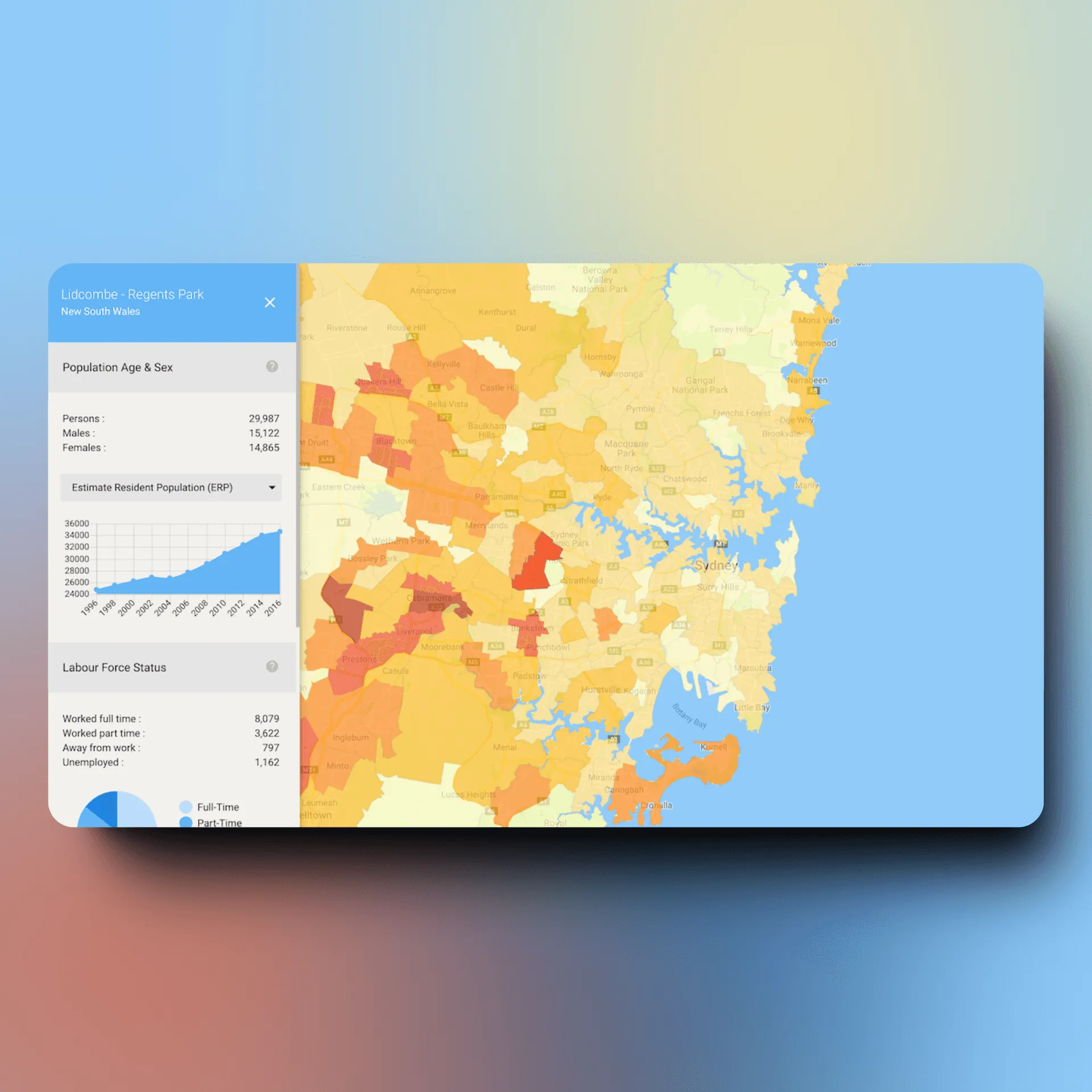
We develop secure, high-performance, browser-based GIS applications that give your entire organization access to critical spatial data without needing specialized desktop software or training. These platforms provide intuitive, user-friendly tools for viewing, querying, and analyzing data, carefully tailored to the specific needs of different user groups. Executives get high-level dashboards for strategic oversight, while field managers can track project progress in real-time. We focus on creating a central, accessible hub for all your geospatial intelligence, breaking down data silos and empowering your entire team to make location-aware decisions. Our platforms are built to be fast, reliable, and scalable, ensuring they perform under pressure as your data and user base grow.
Key Modules & Features

Built for Australian Standards & Data Privacy
We ensure compliance with:
• GDA2020 & MGA2020 Alignment
The Geocentric Datum of Australia 2020 (GDA2020) is the official national datum, providing a more accurate and robust framework for all location data. It's critical for ensuring your data aligns with national standards and is interoperable with government and third-party datasets.
What we do: All our custom geospatial software is built with GDA2020 as its native coordinate system. We engineer robust data pipelines that automatically handle the complex coordinate transformations required to migrate legacy data or integrate data from various sources, ensuring your system is accurate and fully compliant with Australian standards from day one.
Real World Use Cases
How we apply our engineering standards to solve complex problems.
Technologies & Integrations
| System Type | Common Tools | Our Capabilities |
|---|---|---|
| ERP & Financial Systems | SAP S/4HANA, Oracle NetSuite, Microsoft Dynamics 365, Infor, Xero | Asset lifecycle costing, Spatially-aware project cost tracking, Geographically-linked customer billing, Automated maintenance work orders |
| CRM & Sales Platforms | Salesforce, HubSpot, Zoho CRM, Microsoft Dynamics 365 Sales | Network serviceability lookups, Sales territory planning and optimization, Customer location and demographic analysis, Optimized field sales routing |
| Asset & Maintenance Management (EAM) | IBM Maximo, SAP PM, Oracle EAM, Infor EAM, Fiix | Map-based work order management, Asset condition monitoring, GIS-driven predictive maintenance, Real-time field crew dispatch and tracking |
| IoT & SCADA Systems | Azure IoT Hub, Google Cloud IoT Core, Ignition SCADA, GE Proficy, Aveva | Real-time sensor mapping and monitoring, Geographic anomaly detection alerts, Live operational status dashboards, Spatially-driven predictive failure analysis |
| Business Intelligence (BI) & Analytics | Power BI, Tableau, Looker, Qlik Sense | Embedding live, interactive maps in BI dashboards, Spatially-enabled reporting and filtering, Location-based trend and pattern analysis |
Custom vs. Off-the-Shelf Software
Understanding the differences helps you make the right choice for your organization.
Details:
Purpose-built for your exact workflow. Every feature is designed to solve a specific problem and improve your efficiency.Details:
Generic, one-size-fits-all features. You pay for a bloated platform where 80% of tools go unused.Details:
Higher up-front investment, but zero ongoing license fees. Results in a lower Total Cost of Ownership (TCO) over 3 years.Details:
Lower initial cost, but high, recurring annual license fees ($20k-$100k+), plus support and add-on costs.Details:
The software is built to mirror and automate your ideal business process, eliminating bottlenecks.Details:
You are forced to adapt your business processes to the limitations of the software.Details:
Deep, robust integration with your core systems (ERP, CRM, EAM) is a primary design goal, ensuring a single source of truth.Details:
Limited, often requires expensive, brittle connectors or third-party middleware. Creates data silos.Details:
You own the Intellectual Property (IP). You have full control to modify, scale, and evolve the software as your business needs change.Details:
You are renting the software. You are subject to vendor lock-in, price hikes, and their product roadmap.Details:
Built on modern, scalable cloud architecture designed to handle your specific data volumes, now and in the future.Details:
Performance can degrade with large datasets. Scaling often requires expensive enterprise-tier upgrades.Your Expert Geospatial Development Partner
Certifications & Expertise
- Google Cloud infrastructure specialists
- Microsoft Azure development expertise
- GISP (Certified GIS Professional) consultants
Industries Served
- Utilities & Energy
- Environmental & Engineering
- Mining & Resources
- Agriculture
- Government
- Logistics & Transport
Services
- Custom Software Development
- Web & Mobile App Development
- Cloud & DevOps
- System Integration
Technology Stack
Turn Your Spatial Data Into a Competitive Edge
Tired of fighting with inflexible software and disconnected data? We've helped dozens of organizations in the utility, environmental, and surveying sectors build custom geospatial solutions that slash costs and unlock new capabilities. Let's discuss what's possible.
Frequently Asked Questions
While it varies based on complexity, a typical custom geospatial application from us ranges from $75,000 to $250,000. This is a one-time investment. Unlike off-the-shelf software with recurring annual fees of $20k-$100k+, you own the final product. We find most clients achieve a full return on their investment within 18-24 months through reduced licensing costs and significant operational efficiency gains, making it a more financially sound long-term decision.
Our typical development lifecycle for a production-ready custom GIS application is 12-20 weeks. We prioritize delivering a Minimum Viable Product (MVP) quickly, often within the first 8-10 weeks, so you can start getting value and providing feedback. This agile approach, focused on your core needs, means you get a working solution much faster than you would with a traditional, large-scale enterprise implementation that can take over a year to configure and customize.
Both. We are tool-agnostic and choose the right technology for the job. We have deep expertise in building solutions on top of the Esri stack (using ArcGIS Enterprise, ArcPy, and the JS API) for clients heavily invested in that ecosystem. However, we also have extensive experience building highly scalable, cost-effective solutions using open-source technologies like PostGIS, GeoServer, and OpenLayers. Often, the best solution is a hybrid approach, and we'll help you determine the most effective and efficient technology stack for your specific budget and goals.
Absolutely. This is one of our core strengths. We believe the true power of geospatial data is unlocked when it's connected to your core business operations. We build robust, two-way integrations between your geospatial platforms and systems like ERPs (SAP, Oracle), CRMs (Salesforce), and Enterprise Asset Management (EAM) systems (Maximo). This ensures data consistency and allows you to build powerful, cross-functional workflows, such as automatically triggering a maintenance work order in your EAM from a GIS-based inspection app.
Yes. We recognize that clean data is the foundation of any successful GIS. A common first step in our engagements is a data audit and the creation of automated 'Spatial ETL' (Extract, Transform, Load) pipelines. We build scripts to clean, validate, and standardize your disparate datasets into a single, analysis-ready format. This often involves migrating data from legacy formats (like shapefiles or CAD) into a modern, robust spatial database like PostGIS. We fix the data problem first, so your new tools can deliver reliable insights.
We specialize in automating the 'field-to-finish' workflow for surveyors. We can build custom mobile apps for field data capture that enforce your firm's standards, and backend automation to process instrument data, perform adjustments, and generate draft survey plans and reports automatically. Our goal is to free up your licensed surveyors from tedious data wrangling and drafting, allowing them to focus on high-value QA and client management. We've helped firms reduce plan preparation time by over 80%.
Surveying is the precise science of measuring and recording the positions of points on the Earth's surface. It's about creating highly accurate data. GIS (Geographic Information System) is the system used to capture, store, analyze, manage, and visualize that data, often in the context of other information. Think of it this way: a surveyor creates the foundational, high-accuracy data, and a GIS is the powerful platform to analyze that data and reveal deeper patterns, relationships, and trends.
AI and ML are revolutionizing geospatial analysis. We use these technologies to automate tasks that were previously impossible to do at scale. For example, we can train a model to automatically detect and classify objects (like swimming pools, solar panels, or specific tree species) from aerial or satellite imagery. We can use ML for predictive modeling, such as identifying areas at high risk for landslides or forecasting crop yields based on historical data. This turns massive datasets into proactive, intelligent insights.
A geospatial Digital Twin is a dynamic, virtual 3D model of a physical asset, area, or system that is updated with real-time data. It's more than just a static 3D model; it's a living replica. For example, a digital twin of a city could integrate real-time traffic flow, weather data, and utility sensor readings. This allows you to simulate the impact of a new development, model emergency response scenarios, or predict maintenance needs on infrastructure. We build these twins by fusing together BIM, CAD, LiDAR, and IoT data.
Yes, 100%. We have extensive experience working with Australian clients and standards. All our systems are designed to be compliant with the Geocentric Datum of Australia 2020 (GDA2020) and associated MGA2020 grid. We handle all necessary coordinate transformations to ensure your data is accurate and interoperable. We also build in accordance with the Australian Privacy Act and can deploy solutions onshore to meet data sovereignty requirements.
You might, if your needs are very generic. However, off-the-shelf products often force you to change your workflow to fit the software, and you end up paying for dozens of features you'll never use. If you have a specific, high-value workflow you want to optimize, or a unique integration need, a custom solution almost always provides a better long-term ROI. It's the difference between buying a generic suit and getting one tailored to you. One fits okay, the other fits perfectly.